engineering

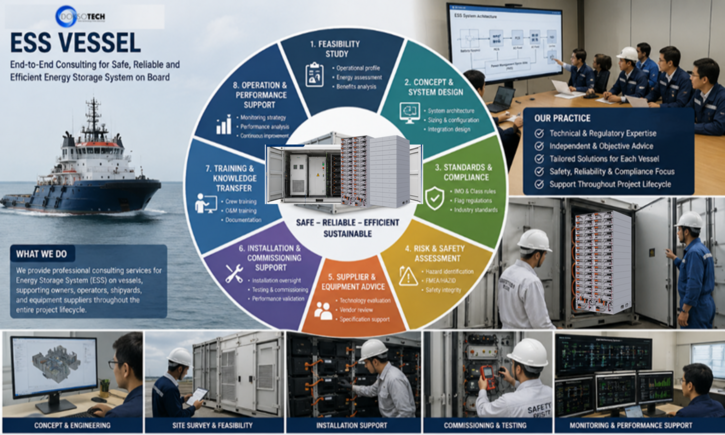
The ENGINEERING process is a series of technical activities that cover the initial stages (planning and feasibility study) all the way to the installation and operation of the E2SS System; generally, it includes:

1.Consultation (including feasibility study).
2.Concept formulation and system design.
3.Setting compliance and applying Risk standards.
4.Coordinating supplier and product/ equipment advice.
5.IC&T (Installation, commissioning and testing).
6.Training and knowledge transfer.
7.Operation support and performance monitoring.

consultation

The use of E2SS – Vessel is a quite new thing in Indonesia, following the same implementation in various other countries. Besides being driven by the availability of increasingly advanced ESS (Energy Storage System) technology, it is also triggered by the need for fuel efficiency in the shipping sector due to the rising cost of fuel/diesel. In line with the ideals and vision of sustainability, the use of E2SS becomes relevant as a practical and solution-oriented option. As a new breakthrough in the shipping world, the implementation and use of E2SS require a deeper understanding of technical aspects, safety standard applications, product certification compliance, service quality, and various financing schemes. DoksoTech provides consulting services for all customers and potential customers to discuss and offer the best solutions to achieve the expected level of efficiency.


concept & design

In general, the design system includes the following elements: (1) Operational Analysis [covering aspects like ship load profile analysis, peak shaving, dynamic positioning, harbor operations, transit operations, and emergency operations]; (2) Battery Sizing [covering the determination of battery capacity (kWh or MWh), battery power (kW or MW), discharge rate (C-rate), charge rate, and autonomy time]; (3) Equipment Selection [covering the selection of battery rack, battery module, battery management system (BMS), power conversion system (PCS), AC/DC converter, energy management system (EMS), HVAC, fire suppression, gas detection, and monitoring system]; (4) Electrical System Design [covering formulation of single line diagram, protection coordination, cable sizing, earthing, short circuit analysis, and harmonic analysis]; and (5) Safety Design [covering thermal runaway analysis, ventilation, escape routes, fire zones, and battery room layout].

compliance & risk

For Energy Storage Systems (ESS) on vessels, compliance and risk management are governed by international maritime regulations, class society rules, and technical standards. The objective is to ensure that lithium-ion battery systems operate safely throughout their lifecycle while minimizing fire, explosion, electrical, and operational risks.

ESS Compliance Standards:

1.IMO Requirements: SOLAS (Safety of Life at Sea), MARPOL Annex VI, and MSC Circulars and Interim Guidelines;
2.Classification Society Rules: Biro Klasifikasi Indonesia (BKI), DNV, Lloyd's Register, American Bureau of Shipping, Bureau Veritas, ClassNK;
3.IEC Standards: IEC 62619 (Safety requirements for industrial lithium batteries), IEC 62933 (Series Electrical Energy Storage Systems), IEC 60092 (Electrical installations in ships), IEC 61850 (Communication architecture), IEC 61508  (Functional safety);
4.ISO Standards.


supply & equipemnt

An Energy Storage System (ESS) Supply and Equipment package for marine applications includes all hardware, electrical equipment, control systems, safety devices, and auxiliary components required to integrate battery energy storage into a vessel.

The package is typically designed in accordance with IMO regulations, class society rules (BKI, DNV, ABS, LR, BV, ClassNK), and IEC marine standards.

ic & t

Installation, Commissioning and Test (IC&T)

The successful deployment of a Marine Energy Storage System (ESS) requires a structured process covering installation, commissioning, and performance testing. These activities ensure that the ESS operates safely, reliably, and in compliance with IMO, SOLAS, IEC 60092, and classification society requirements (BKI, DNV, ABS, LR, BV, ClassNK).

1.ESS Installation.
2.Pre-commissioning.
3.Commissioning.
4.Performance testing.
5.Safety testing.
6.Harbor Acceptance Test (HAT).
7.Sea trial.
8.Documentation and deliverables.


training

ESS Vessel Training is a structured program designed to equip ship crews, maintenance personnel, and technical staff with the knowledge and practical skills required to safely operate, monitor, maintain, and respond to emergencies involving a Marine Energy Storage System (ESS). Training should comply with IMO, SOLAS, and the requirements of the applicable classification society (BKI, DNV, ABS, LR, BV, or ClassNK).

Training objectives (Participants will be able to):

§Understand ESS architecture and operating principles.
§Operate the ESS safely during normal vessel operations.
§Monitor battery performance using the BMS and EMS.
§Perform routine inspections and preventive maintenance.
§Identify and respond to alarms and faults.
§Execute emergency shutdown procedures.
§Handle battery-related fire and thermal runaway incidents.
§Comply with safety regulations and operational procedures.

operation

Operation and Performance Support for a Vessel Energy Storage System (ESS) is a comprehensive lifecycle service that ensures the battery system operates safely, efficiently, and reliably while maximizing battery life, minimizing downtime, and maintaining compliance with IMO and classification society requirements.

Service Scope:

1.Operational support.
2.Performance monitoring.
3.Remote monitoring center.
4.Preventive maintenance support.
5.Performance optimization.
6.Predictive maintenance.
7.Technical support.
8.Spare parts support.
9.Operational reporting.